Sunday, May 3, 2009

How Supermarkets Lure You To Buy More


Consumer Reports retail expert Tod Marks explains to Susan Koeppen of CBS's The Early Show that supermarkets exist to make a profit for their shareholders. Hence, everything from product placement to lighting is designed to lure you to buy a product. What can you, as an aspiring frugal shopper, do? Mark outlines 5 key steps:
  1. The first thing to do when you go to the store is pick up the flyer.

    My take: I go one step further and visit the store's website to see what's on sale before I leave my home. I find that the best way to avoid the temptation of impulse buying, which is how supermarkets maximize their profits, is to visit the websites of my favorite stores, see what's on sale and plan accordingly.

    Mark further explains:
    "But just because something is featured in a flyer doesn't mean it's on sale. It may not mean it's a great deal at all ... It may mean a manufacturer paid advertising dollars toward the mention of that product."
    My take: I have experienced this firsthand. Burt's Bees (my favorite brand of personal care products) pays for product placement in Target and Walgreens weekly flyers. I notice that the Burt's Bees product placement in these flyers conveniently avoid mentioning the world "Sale Price" - a clear indication that the price is full retail price, and sure enough it is.

  2. The End of the Aisle -- The "End Cap" -- Is the Single Hottest Selling Spot in the Entire Store
    My take: You can sometimes find clearance items or bargains of slow moving items at the "end cap" but always check the expiry date or condition of the product before buying.

  3. Product Placement Is Key
    Mark says: "Prime selling space is right in the center, eye-level if you will ... The lower level and the high-on-top level, they're kind of the low-rent districts..."
    My take: You can find bargains if you are willing to bend down and look at the price. Supermarkets often capitalize on our laziness: we grab things at eye level and don't want to bother bending down or craning our necks to search for less expensive products.

  4. Convenience Will Cost You
    My take: How true, when you compare, e.g., the price of prepackaged salads with that of a head of lettuce.

  5. Saving Money Is in the Bag"
    Generally speaking," Marks says, "the better deal is almost always to be had when you buy the bag versus the loose produce."
    My take: You pay for the privilege of selecting your produce. While it is true that in a bag of apples there may be one or two that might be bruised, it's still cheaper per pound than selecting your own apples.

Friday, May 1, 2009

Frugal Tip: Putting Citrus Fruits to work as Household Cleaners

One frugal habit I have is substituting commercial cleaners with their potent chemical formulations with traditional natural alternatives using lemon and other citrus fruits. Besides the obvious fact that using lemon and other citrus fruits as cleaners save money, they also do not have the potent chemical concoctions that cause headaches and leave behind toxic residues that pollute groundwater or damage the environment. If you would like to try but do not know how to get started, here are two links with lots of tips and ideas:

Thursday, April 30, 2009

Suze Orman's Recession Rescue Plan

If you are one of those who follow Oprah's daily TV show, you might have caught Oprah's favorite financial guru, Suze Orman expounding on her Five-Step Recession Rescue Plan. Her five-step plan is simple but requires a fair measure of discipline:
  1. Learn to live on half what you're used to and save the other half.

  2. Stash your cash, especially since credit card companies are becoming less generous.

  3. Make the Federal Stimulus Package work for you.

  4. Make your home affordable.

  5. Look at what you have and not what you had.
In other words, Suze is saying the things I have practiced all my life: be frugal. Save. Plan for unforeseen circumstances, e.g., losing one's job or getting a pay cut.

Suze advocates a 8-month emergency fund. I am planning for 12 months. She says, "no credit card usage, everybody, Pay for things in cash." As I explained in an earlier blog, I use credit card to leverage a monthly interest float and get rewards points. But Suze has a point: if you aren't disciplined enough to budget with a credit card and keep track of your daily credit card expenses, you are better off using cold, hard cash.

Wednesday, April 29, 2009

Balancing Frugality with Healthy Living

Many of my colleagues and friends have asked me how I reconcile my frugality with my desire to maintain a healthy living lifestyle. Isn't it the case, I get asked, that manufacturer coupons are usually for processed foods that are laden with artificial colorings, preservatives or flavorings? I concede that many of the manufacturer coupons in the Sunday newspaper inserts are for processed food that I don't care much about. But it is possible to live frugally and healthily. Here's how I do it:
  • I avoid all processed foods with artificial colorings, flavorings, preservatives, as well as artificial stuff like trans fat, hormones, etc. That means most of the coupons in the Sunday newspapers are out.

  • I used to love red meat but gave it up after my doctor diagnosed me with high cholesterol several years ago. If you think this is extreme, latest medical research points to a whole host of health problems associated with consuming a diet that is rich in red meat.

  • As far as possible, I eat fresh vegetables, meat, nuts, chicken and fish. Rather than buying frozen prepared meals, I buy the ingredients and cook them myself. I buy organic produce, meat, milk and eggs from my two favorite shopping destinations: Trader Joe's and Whole Foods.

  • At both Trader Joe's and Whole Foods, I buy their store brands (Trader Joe's and the "365" brand for Whole Foods). I find Trader Joe's private label products meet or even exceed commercial brands. For example, I absolutely love Trader Joe's Organic Concord Grape Jelly, which tastes so much better and costs much less than competing products (e.g., Cascadian Farm). Similarly, Whole Food's 365 brand Organic Morning O's are tasty and easy on the wallet, compared to competing products from Cascadian Farm, Kashi, etc.

  • Wherever possible, I use manufacturer coupons to purchase organic products. If I can combine manufacturer coupons with sales, that's even better. For example, I use Organic Valley's manufacturer coupons from Mambo Sprouts, Whole Foods' Whole Deals coupon booklets and Organic Valley's coupon page to purchase Organic Valley products (milk, eggs, butter, etc.). I buy my Organic Valley eggs and milk at Whole Foods using Organic Valley coupons from Mambo Sprouts printed and online coupons booklets.

More Reviews on the new Honda Insight hybrid


Here are more reviews and articles on the new Honda Insight hybrid:
I have also blogged about my interest in the Honda Insight: Honda Insight Launch

Sunday, April 26, 2009

Credit Cards & Frugal Living

Credit cards issuers have gotten a very bad rap for their aggressive tactics. Even President Obama has gotten into the act, pressuring credit card issuers on rates. As far as I am concerned, credit cards are like guns, i.e., you can either use them to your benefit or abuse them at your peril. In the industry parlance, I am what the credit card issuers call a "deadbeat," i.e., someone who pays the entire monthly credit card bill on time, i.e., I do not carry a monthly balance. In my opinion, carrying a credit card balance is like entering Hotel California, you can enter but you can't leave :-)

Having said that, let me share my ground rules on my credit card usage:
  1. I draw up a monthly budget for my expenses, allocating funds for recurring expenses (e.g., utility bills, groceries, etc.) and giving myself a reasonable allowance for unexpected expenses.

  2. I divide up my monthly income to cover my expenses. If I don't have enough funds for a specific expense, I either postpone that expense until I have saved enough funds, or I cut my discretionary spending to cover that.

  3. I keep my funds in my ING online high yield savings and use my credit cards to pay those bills.

  4. In other words, my credit cards function like a monthly float, allowing me to earn some interest, albeit a pittance as a result of the Fed's generous bailouts to banks.

  5. I keep track of all my daily credit card expenses in my Excel spreadsheet. If I made any unexpected credit card expense on a specific day, I immediately readjust my monthly budget in my Excel spreadsheet accordingly. This way, I never spend more than what I allocate. In other words, I have trained myself to treat my credit cards as if they were like cash. It requires discipline and over the years I have gotten better at it.

  6. When the time comes to pay my monthly credit bills, I transfer the funds from my ING online high yield savings to my ING Electric Orange checking account and arrange for payment of my credit cards.

  7. This way, I not only avoid carrying cash but also earn a monthly interest float and also the purchase protection that credit cards issuers offer.

  8. In addition, I use only fee-free premium credit cards, aka rewards cards. I avoid all credit cards that require me to pay an annual fee or credit cards with no rewards. In addition, I have no use for credit cards with low interest rates, since I pay off my monthly credit card bill in full.

  9. Currently, I am using Citibank's Diamond Preferred Mastercard with Thank You Rewards and American Express' Blue Card with Membership Rewards. My Citibank Diamond Preferred Mastercard is my principal credit card. I normally redeem the Thank You points for statement credit. For a long time, I used this card regularly because it offered me 5 Thank You points for gas, drugstores and supermarkets. This would mean that I not only earn interest on my monthly float, I also get regular and bonus points that I redeem for statement credit, thereby lowering my monthly credit bill even further.

  10. A few years ago, Citibank reduced that to double Thank You points for those categories. Early this year, Citibank eliminated those bonus points. If I get a better credit card deal, I would definitely consider switching to a different credit card.

  11. I used to have a AAA Visa with Gas Rebate (then issued by MBNA). After Bank of America took over and got rid of the gas rebates, I stopped using my card and last year Bank of America unilaterally closed that card without notifying me. I only found out when I did a routine quarterly check on all my various dormant account and discovered that Bank of America closed my AAA credit card.

  12. My Amex Blue card is my oldest credit card, dating all the way from my college days. This card started out as an Amex Blue credit card for students that Amex upgraded to a standard card once I graduated from college. I keep it alive to maintain my FICO credit score, since a portion of a person's FICO score is determined by length of credit history. After my bad experience with Bank of America closing my AAA credit card unilaterally without prior notice, I use my Amex Blue card once or twice a month to keep it alive.
If you have any good credit card tips, please let me know.

Friday, April 24, 2009

Buy now or later? Planning for Summer Travel

If you are one of those who are planning a vacation this summer and waiting for the prices of airfares to drop, you might be interested in the discussion of buying strategies in this New York Times' Practical Traveler column, Airfare Debate: Buy Now or Wait? This article discusses the pros and cons of buying now or waiting, tracking fares at different online sites, and offers these words of advice:
But predicting airfares is a bit like forecasting the weather. Even with the most sophisticated technology, you can still be way off. Ultimately, travelers must decide for themselves when to push the buy button.
For my earlier discussions:
Orbitz's New Marketing Tactic: Full Disclosure of Actual Pricing
Frugal Traveling Strategies


Orbitz's New Marketing Tactic: Full Disclosure of Actual Pricing

Online travel agency Orbitz.com announced that it would start including all taxes and fees in its initial price display for hotels on Orbitz.com instead of just the base rate, in an attempt to stimulate loyalty among price-sensitive customers amid economic recession (source: Reuters).

I have shared my views on the online travel booking websites that I frequently use: Frugal Traveling Strategies

Recycling Your Tech Stuff

Are you one of those who have accumulated all kinds of electronic gadgets and equipment that have become obsolete and now gathering dust somewhere around your home? Why not recycle them? You could get a tax write-off or even cold hard cash. This Computerworld article, Recycle Your Tech Gear: It's Easier Than You Think explains to you the ins and outs of tech recycling and how you could even get some cash from your old stuff.

Thursday, April 23, 2009

Thift Nation

This week's Time Magazine devotes its attention on a topic that is the subject of this blog: thrift and frugality. Its central theme is that Americans are reacting to the great recession of 2008 with "big changes in attitudes and spending habits, but they're not giving up hope." Here's what you can expect to read and ponder over:

Wednesday, April 22, 2009

New Car Buying Tips & Avoiding Car Dealer Tricks

The website carbuyingtips.com gives lots of good advice, strategies, and tactics for buying a car and avoiding being taken for a ride by the dealer. It teaches you about how dealers squeeze money from car buyers and how you, as a buyer can save by understanding the strategies and tactics used by dealers.

Tuesday, April 21, 2009

Toyota Trims Price of Prius to compete with Honda's Insight Hybrid

Toyota has decided to lower the prices of their 2010 Prius to compete with Honda's new Insight hybrid, which will be officially launched on Wednesday, April 22, 2009. This is good news for those looking to save money on new hybrids.

See also my blog posting yesterday: Honda Insight launch

Monday, April 20, 2009

Honda Insight Launch

I received a mailing from my local Honda dealer to an invitation only launch of the new Honda Insight hybrid this Wednesday evening (Apr 22). Unfortunately, I won't be able to make it, since I have another appointment at that time. Moreover, as an early adopter who bought one of the earlier Honda Fit to arrive in the U.S. 3 years ago (April 2006), I am still ecstatic by my Honda Fit, which is a frugal yet chic/sporty car. When I have the time, I'll blog about my experiences after having this car for 3 years now. Anyway, for those interested in the new Honda Insight hybrid, here are links to information to satisfy your curiosity:
Other Useful Information from Honda's Official Media Kit:
I'd be interested in any comments/feedback from any early adopter who has bought a production model of the Insight.

Trader Joe's Fan Sites

As a frugal connoisseur, I am eternally grateful for Trader Joe's, my favorite food destination for amazing, delectable yet cheap private label gourmet treats. Unlike other grocery stores and supermarkets, Trader Joe's website is very spartan. Enter fan sites, which can be a useful source of information:
  • Trader Joe's Twitter: Tweets by and for Trader Joe's aficionados. This is a very active tweet community. I find it especially useful to get daily fix/updates about new products, reviews, etc.

  • Trader Joe's Fan: An active fan site with reviews, recipes, etc. Unfortunately, its twitter page isn't updated as reguarly :-(

  • Tracking Trader Joe's: Outdated: This blog started out well but is no longer maintained/updated. What a pity.

Sunday, April 19, 2009

A Golden Age for Cheapskates


Today's Washington Post's article, A Golden Age for Cheapskates and its companion piece, Deals are Just A Click Away both speak volumes about how more and more Americans are rediscovering the joys of frugality in this depressed economy. Landing freebies has become the national pastime and businesses are taking notice. As the main article explains:

The recession has emboldened a certain kind of consumer: The mooch. With dwindling retirement savings, a higher cost of living and wobbly job market, they don't just want discounts on items they used to pay full price for without a second thought. They want freebies -- meals, magazine subscriptions, toiletries, you name it. They scour the Internet, make clever use of coupons or simply take advantage of struggling shops and restaurants that are increasingly giving away free things to lure customers.

"One of the things that makes us feel smart is getting something for free," said Matt Wallaert, a behavioral psychologist at JustThrive.com, a free online personal financial advisory service for people in their 20s and 30s. "During a recession, frugal is not a bad word. It's a good word. This is something that people are supposed to be doing. So people think, 'I've got to get on board.' They're searching for free more than ever because it's a symbol of financial savviness."
...
Another sign that consumers are increasingly searching for free items is the growing popularity of coupons. Coupon redemption on consumer packaged goods increased 16.7 percent in the fourth quarter of 2008 from the same quarter a year earlier, according to Valassis, a media and marketing services company. Savvy shoppers know that using coupons on days when stores have double or triple coupon promotions can lead to free goods.

Saturday, April 18, 2009

Frugal Living & Managing Risk, IV

In response to the e-mails that I received with regard to my "Frugal Living & Managing Risk" series:
  1. Aren't you a bit too conservative in your strategy? How would you ensure that you do not outlive your retirement savings?
    This is a good question. What most people forget is that stocks are inherently risky investments. There is no such thing as risk-free stocks. While stocks offer the potential of good returns, I would also argue that stocks carry significant risks that people ignore at their own peril. Those who focus on the fact that the long term average return of stocks beat other investments often forget that historical figures indicative of future performance. When investments dropped 30%-40% in 2008, it is really painful and will take a long time to recover. The stock market cannot guarantee an annual 10%-20% return to make up for a 30%-40% drop in 2008. Hence, I stand by my decision to invest in stable-value funds, a decision I made in 2006.

  2. Would you ever invest in stocks or mutual/index funds?
    I don't rule out investing in stocks, index funds or mutual funds. My strategy comprises keeping my 401K and emergency fund in conservative investments (stable value funds for my 401K and high yield savings/CDs for emergency fund). Once I fully fund my 401K (to its annual tax-free limit) and emergency funds (to 1 year's worth of expenses), then I would invest in stocks, index funds, mutual funds, etc.., which I would consider as my "extra investments." If I lose any money in my "extra investments," the losses would be limited to the "extra" money that I could afford to lose. Retirement and emergency funds are money that I cannot afford to lose. In other words, I have deliberately adopted a conservative investment strategy that requires me to save more, rather than to take higher risks. The 2008 financial crash is a reminder to us that an aggressive investment strategy is no antidote to inadequate savings.
Previous postings in this series:
Frugal Living & Managing Risk, I
Frugal Living & Managing Risk, II
Frugal Living & Managing Risk, III

Friday, April 17, 2009

Frugal Living & Compact Fluorescent Lamps (CFLs)

Compact fluorescent lamps (CFLs) have been in the news lately. Columnist George F. Will wrote a recent op-ed piece on CFLs in the Washington Post (April 2, 2009). A week earlier, the New York Times discussed the challenges of using CFLs in an article, Do New Bulbs Save Money If They Don't Work? Depending on who you're talking to, CFLs are either praised or villified.

I have been using CFLs in my home since 2003 and haven't encountered the problems that are highlighted in the Washington Post and New York Times articles. Here's how I use CFLs in my house:
  • CFLs are not meant to be used in areas that are exposed to the elements outside one's house. Neither would they work work in temperatures below freezing. Extreme moisture from the rain and cold weather would significantly degrade the built-in fragile electronic ballast that lights a typical CFL, thereby shortening its lifespan. Hence, I continue to use incadescent lamps outside my house.

  • Standard CFLs do not work in dimmers. As I am too frugal to buy the more expensive CFLs that would work with a dimmer, I continue to use incadescent bulbs in fixtures with dimmers.

  • I use CFLs in the kitchen, in table lamps and floor lamps in living areas, and in the bathroom. Notwithstanding the advice not to use CFLs in three-way floor lamps, I have not had any problems using CFLs in the three-way floor lamps that I bought from Target.

  • I have been using GE CFLs exclusively (no, I don't work for GE). GE CFLs are typically more expensive than store-brand CFLs from Wal-Mart, Home Depot, etc. I buy GE CFLs when they are on sale at Target and using manufacturer coupons to lower the price. I stocked up on GE CFLs when I combined the then $2.00 off manufacturer coupons (no longer available now) with Target's sale on their buy two get one free pack of CFLs a few years ago. I bought enough CFLs then to last for a long, long time.

  • The GE CFLs that I have been using last any where from 3 to 4 years. I never had any CFL failing before 3 years. So long as I do not use them in enclosed fixtures (where temperature in the electronic ballast could build up and shorten its lifespan) or in outdoor fixtures (where rain and extreme cold would likewise shorten the ballast's lifespan), I see no reason why CFLs wouldn't last their advertised lifespan.

  • I think more could be done to educate people on how to use CFLs. CFLs are not always appropriate for all fixtures and locations. I am not sure whether labelling is the solution, since most folks don't read the fine print.

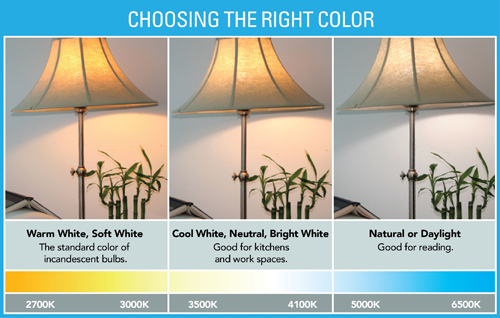
  • As for the color, I haven't had any problems with color. Most complaints about the color stem from a misunderstanding about color temperature of CFLs. Here is how color temperature works. Color temperature is measured in Kelvins (K). The lower the number (2700K), the yellower the color. The higher the number (6000K), the bluer the color.
  1. Standard incadescent "warm bright" color: 2700K-3000K

  2. Cool white color: 3500K-4100K

  3. Standard white fluorescent color: 5000-6500K


  • I have CFLs that are 3000K-3500K. At 2500K, they almost replicate the warm bright color of incadescent bulbs. I think the problem lies in the fact that most CFLs do not come labelled with their color temperature. One has to do some sleuthing over the internet.

  • As for the question of mercury, I have always recycled my used CFLs. For a while, I recycled my CFLs through my employer, which has a contract to recycle the fluorescent tubes used in the office. Although I haven't had the occasion to do so, I am happy that Ikea, Home Depot and WalMart have drop-off CFL recycling programs. I may take advantage of these opportunities.
FREE OFFER: Home Depot is offering a free CFL (available in-store only) on Sunday, April 19, 2009.

For more information:

PineCone Research Sign-up Link (won't last long)

PineCone Research is looking for new members. Here's the elusive sign-up link (Warning: won't last long).

See my earlier blog post about PineCone Research and other paid survey sites.

(via mymoneyblog.com)

Thursday, April 16, 2009

Free access to Wall Street Journal via iPhone app

If you are a regular reader of the Wall Street Journal (whether print or online), you would know that the Wall Street Journal, unlike its competitors, charges for access to digital/online content. There's a way to save money by accessing WSJ's digital content for free via WSJ's iPhone app. Find out more in Wired.com Blog's article, Wall Street Journal iPhone App Sets Content Free. If you own an iPhone, this could be a way to save money accessing WSJ's digital content.

Wednesday, April 15, 2009

UPDATE: New York Time's Frugal Traveler Column on Netbooks

After I shared my own experiences with my newly acquired netbook, which has displaced my heavier ThinkPad R52 to become my principal travel computer (and companion), lo and behold, the New York Times' Frugal Traveler Column agrees with me in its latest column (published April 15, 2009): Lighter on Laps and Wallets.